
This guide contains affiliate links to Booking.com. If you book through them, we may earn a commission at no extra cost to you. Learn more.
Orlando hurricane season runs from June 1 to November 30, the same dates as the official Atlantic hurricane season, and its busiest stretch falls from mid-August to mid-October. That overlaps with summer vacation, Labor Day and the start of the fall festival season, so many Orlando trips land inside it.
Afternoon thunderstorms are the weather you’re most likely to meet. Hurricanes are a less frequent threat, but Central Florida has felt several serious ones in recent years, and when one comes, parks can close and flights stop. This guide covers what NOAA says about timing, how storms actually affect inland Orlando, what Disney and Universal promise, how to book a hotel you can cancel, and what to do if a storm heads your way.
Quick answer: Orlando hurricane season is June 1 to November 30, with the peak around September 10. You don’t need to avoid it, but book refundable hotel rates, learn how Disney’s and Universal’s hurricane policies work (both are triggered by an official warning within seven days of arrival, Universal also counts a declared state of emergency, and both cover only bookings made directly with them), buy any travel insurance before a storm is named, and follow local officials if a warning is issued.
Check Orlando hotel prices for your dates
On this page
Orlando hurricane season dates and peak
The National Hurricane Center (NHC) defines the Atlantic hurricane season as June 1 to November 30, and notes that storms sometimes form before or after those dates. Its climatology page puts the statistical peak on September 10, with most activity between mid-August and mid-October.

Based on the 1991–2020 climate period, NHC says an average season produces 14 named storms, 7 hurricanes and 3 major hurricanes (Category 3 or stronger). Those are basin-wide numbers: they cover the Atlantic, the Caribbean and the Gulf, and most of those storms never reach Florida.
| Period | What NHC says | What it means for your trip |
|---|---|---|
| June to July | First named storm usually mid to late June | Fewer storms; afternoon thunderstorms are the main issue |
| August | First hurricane usually early to mid-August | Activity ramps up; book flexible rates |
| Mid-August to mid-October | Most active part of the season; peak Sept. 10 | Busiest stretch basin-wide; keep plans flexible |
| Late October to November 30 | Season continues, activity usually lower | Activity usually tapers; keep watching forecasts |
If you’re still choosing travel dates, our month-by-month guide to the best time to visit Orlando weighs weather against crowds and school breaks.
How often do hurricanes affect Orlando?
Orlando sits inland, roughly in the middle of the peninsula, so it doesn’t face the storm surge that drives coastal evacuations. Orange County’s own hurricane guide is clear, though, that Central Florida “certainly isn’t insulated” from storms: the hazards here are high winds, tornadoes and flooding.
NOAA doesn’t publish a simple “chance a hurricane hits my Orlando vacation” figure, and you should be wary of anyone who quotes one. What official storm reports do show is that the Orlando area has felt at least three significant hurricanes in the past decade:
| Storm | Date | Impact in the Orlando area (official reports) |
|---|---|---|
| Hurricane Irma | September 2017 | Center passed between Tampa and Orlando as a Category 1; residents rescued from flooded homes in Orange County |
| Hurricane Ian | September 2022 | 10–20 inches of rain in central and eastern Florida; major flooding in Orange, Osceola and Seminole counties |
| Hurricane Milton | October 2024 | Orange County under a hurricane warning; tornadoes and 10–15+ inches of rain across east central Florida |
The NHC’s report on Irma notes that about 4,000 structures were damaged in Osceola County, near Orlando, and its Ian report estimates about 4,100 damaged structures in the same county. For Milton, the National Weather Service office in Melbourne counted at least 19 confirmed tornadoes in east central Florida, and the NHC recorded 14.83 inches of rain at an observer site near Orlando.

Milton also shows what a direct threat does to a vacation. Disney said in its earnings release that Walt Disney World Resort “was closed for a day” because of the storm. Orlando International Airport (MCO) ceased commercial operations at 8 a.m. on Wednesday, October 9, 2024, and Orange County reported that outbound flights resumed on Friday, October 11. The county sheltered more than 2,600 people during the storm.
Hurricane season vs. the rainy season
Don’t confuse the two. According to the National Weather Service, Orlando’s rainy season typically starts in late May and the dry season in mid-October, and summer brings frequent afternoon thunderstorms, often when sea breezes from both coasts collide inland. Those storms are the weather you’re most likely to meet, and lightning can pause outdoor rides, pools and water parks.
A tropical storm or hurricane is a different event: a large system tracked for days by the NHC, with official watches and warnings.
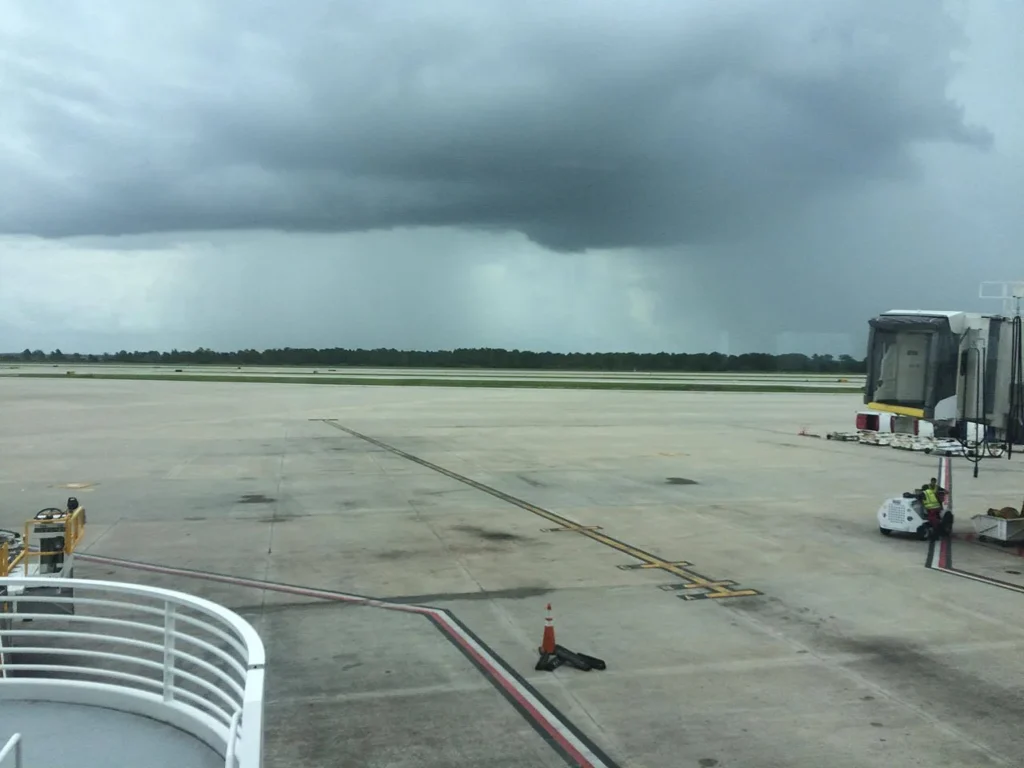
For ordinary storm days, our guide to things to do in Orlando when it rains lists the best indoor rides and attractions.
Watches and warnings: the words that trigger park policies
Disney’s and Universal’s hurricane policies both depend on official NHC warnings (Universal also counts a declared state of emergency), so it helps to know exactly what they mean. According to the National Weather Service:
- Hurricane watch: hurricane conditions (sustained winds of 74 mph or more) are possible in the area. NHC issues watches 48 hours before it expects tropical-storm-force winds.
- Hurricane warning: hurricane conditions are expected. NHC issues warnings 36 hours before tropical-storm-force winds, and “all preparations should be complete.”
- Tropical storm warning: sustained winds of 39 to 73 mph are expected within 36 hours.
- Tornado warning: a tornado has been sighted or indicated by radar; Orange County counted over 42 across Central Florida during Milton. Its advice is to move to an interior room on the lowest floor of a sturdy building and avoid windows.
The practical point: because warnings come only about a day and a half ahead, a park’s hurricane policy usually kicks in close to your travel date, not weeks before. A forecast cone or a scary headline a week out doesn’t trigger these policies on its own.
Disney World hurricane policy
Disney’s help pages are built in JavaScript and are hard to read outside a browser, so this summary uses a May 2022 archived copy of Disney’s US hurricane FAQ, the latest we could read in full. Confirm the current policy with Disney. That version said:
- Trigger: the NHC issues a hurricane warning for the Orlando area, or for your place of residence, within 7 days of your scheduled arrival.
- What’s covered: you can reschedule or cancel a Walt Disney Travel Company Disney Resort Hotel package and most room-only reservations booked directly with Disney, without change or cancellation fees imposed by Disney.
- What isn’t: certain special events and dining experiences. Airlines, other hotels, car rental companies and insurers keep their own rules and fees.
- Booked elsewhere: the policy covers direct Disney bookings only, so ask any other seller about its own rules.
Disney also runs a weather updates page and says it will post important information there during a tropical storm or hurricane, noting that some experiences “can be delayed, rescheduled or cancelled due to severe weather.” Check it and the My Disney Experience app before you travel. Weighing an on-site stay partly for this protection? Our guide on whether a Disney resort is worth it compares the other perks.
Universal Orlando severe weather policy
Universal’s policy, published by Universal Parks & Resorts Vacations (checked via a June 2026 capture of the official page), is a little broader than Disney’s:
- Trigger: the NHC issues a hurricane or tropical storm warning, or a state of emergency is declared, for the Orlando area or your place of residence within seven days of your arrival.
- What’s covered: Universal Parks & Resorts Vacations packages, room-only hotel stays and Universal Orlando theme park tickets booked directly with Universal Orlando can be rescheduled or canceled without change or cancellation fees.
- What isn’t: certain special events, dining experiences and group bookings, and hotel reservations made after the warning or state of emergency was issued. Airline fees can still apply to flights in a package.
- Booked elsewhere: products bought through third parties, travel agents or tour operators follow those sellers’ policies.
Universal also notes that the same rooms and rates aren’t guaranteed when you reschedule. If you’re comparing on-site and nearby stays, see our guide to hotels near Universal Studios Orlando.
SeaWorld Orlando’s Weather-or-Not Assurance
SeaWorld says the park usually stays open in bad weather. Its year-round Weather-or-Not Assurance offers a return visit if weather causes an early closure, if rides close for more than 60 minutes because of lightning, wind, heat, rain or snow, or if the heat index reaches 110 degrees. You need your original ticket or order number, and requests must be made within one week. Pass Members, complimentary tickets, 14-Day Length of Stay tickets and Discovery Cove packages are excluded. SeaWorld also has a form for when extreme weather affects your flights to an upcoming visit.
| Park | Trigger | Covers | Key limit |
|---|---|---|---|
| Walt Disney World | NHC hurricane warning within 7 days | Disney packages, most room-only stays | Direct bookings only |
| Universal Orlando | Hurricane or tropical storm warning, or state of emergency, within 7 days | Packages, room-only stays, park tickets | Direct bookings only |
| SeaWorld Orlando | Weather disrupts your visit | A return visit | Request within one week |
Booking an Orlando hotel in hurricane season
The park policies above don’t protect a hotel you booked somewhere else. Booking.com’s terms say that if you cancel or don’t show up, any fee and any refund depend on the property’s own cancellation policy, and that some bookings can’t be canceled for free while others are free only before a deadline. Don’t assume a storm will get a non-refundable rate waived.
- Pick free cancellation: for trips between August and October, a rate you can cancel a day or two before arrival is worth a small premium.
- Read the deadline: note the exact cancellation cutoff and time zone in your confirmation.
- Pay later when possible: some rates are paid at the property rather than upfront, but check the fine print for any deposit or prepayment.
- Think about indoor space: a hotel with restaurants, an indoor pool or a covered atrium makes a stormy day far easier. Our list of Orlando hotels with indoor pools rounds up the options.
- Location matters less than you think: no part of the Orlando tourist area is immune, so choose by your park plan. Our guide to where to stay in Orlando compares the main areas.
One resort built around indoor space is Gaylord Palms Resort & Convention Center in Kissimmee. At last check (a May 2026 archived copy of its Marriott page), the resort described 4.5 acres of glass atriums kept at 72 degrees, with Villa de Flora restaurant inside the garden atrium. Its Cypress Springs water park sits outdoors, so it won’t help in a storm. Our Gaylord Palms review covers fees and transport.

Check your dates for Gaylord Palms Resort & Convention Center on Booking.com
Rates vary by season, availability and how far ahead you book.
Travel insurance basics for hurricane season
We don’t recommend specific policies, but the National Association of Insurance Commissioners (NAIC), the organization of state insurance regulators, offers useful ground rules:
- Buy early: the NAIC says that if you wait until a storm has been named, your policy likely won’t cover claims related to it.
- Foreseeable events: travel insurance is meant for sudden, unforeseen events, so buying it two days before a trip with a hurricane already forecast isn’t likely to help.
- Cancel for Any Reason (CFAR): usually an add-on that costs more, must be bought within a set time after booking and typically repays only part of your trip cost.
- Check your credit card: the NAIC notes some cards include trip cancellation coverage, so see what you already have before you buy.
What to do if a storm threatens your trip
If a tropical system is heading for Florida before or during your stay, work through these steps:
- Follow official forecasts: use the NHC (hurricanes.gov) for the track and the National Weather Service in Melbourne for local conditions in the Orlando area.
- Call before you travel: if a warning is issued within seven days of arrival, contact Disney or Universal for direct bookings, and your hotel or Booking.com for everything else. Contact your airline about flights.
- Get local updates: Orange County posts storm resources and information at ocfl.net/storm. If you’re staying in Kissimmee or elsewhere in Osceola County, follow that county’s updates too.
- Stay put in a sturdy hotel: Florida’s Division of Emergency Management says the greatest threat to life from a hurricane is storm surge flooding, and that people who are not in an ordered evacuation zone, a flood-prone area, a mobile home or an unsafe structure may be safer staying put. Always follow your hotel’s instructions and orders from local officials.
- Don’t head to the airport to wait it out: MCO’s own Milton update said the airport “is not an authorized shelter.” Check flight status with your airline first.
- Avoid flooded roads after the storm: Orange County warned of roadway flooding in several neighborhoods during Milton, and inoperable traffic lights should be treated as four-way stops.
Orange County opens public shelters when needed and says ID cards are not required to enter. If flights are canceled and you need an extra night near the terminal, our guide to Orlando airport hotels lists in-terminal and shuttle options.
The rest of the year: see Orlando weather by month.
Storm season month by month: Orlando in June, Orlando in July, Orlando in August, Orlando in September, Orlando in October, Orlando in November.
Frequently asked questions
When is hurricane season in Orlando?
Orlando follows the official Atlantic hurricane season, which runs from June 1 to November 30. The National Hurricane Center puts the peak around September 10, with most activity between mid-August and mid-October. Storms are less common in June, July and November, but they can still form, and storms occasionally form outside the official dates, so check forecasts in the week before any trip.
Is it safe to visit Orlando during hurricane season?
For most travelers, yes, with some planning. The NHC tracks storms for days and issues watches about 48 hours before tropical-storm-force winds, Orlando is inland and away from storm surge, and Disney, Universal and SeaWorld all publish weather policies. The real risks are disrupted plans and costs: park closures, canceled flights and non-refundable bookings. Book flexible rates, watch the NHC forecasts, and follow local officials and your hotel if a warning is issued for the area.
What is Disney World’s hurricane policy?
In Disney’s May 2022 FAQ (the latest we could read), if the National Hurricane Center issues a hurricane warning for the Orlando area or your home area within 7 days of your arrival, Disney lets you reschedule or cancel Walt Disney Travel Company packages and most room-only reservations booked directly with Disney, without Disney’s fees. Certain special events and dining experiences are excluded, and airlines and other third parties keep their own rules. Confirm the current terms with Disney.
Does Universal Orlando refund tickets for hurricanes?
Under its severe weather policy, Universal lets you reschedule or cancel packages, room-only hotel stays and Universal Orlando theme park tickets booked directly with Universal, without fees, if a hurricane or tropical storm warning or a state of emergency is issued for Orlando or your home area within seven days of arrival. Tickets bought through third parties follow the seller’s rules.
Should I buy travel insurance for a Florida trip in hurricane season?
It depends on how much you’d lose if you had to cancel. If you buy it, buy it early: the NAIC warns that a policy bought after a storm is named likely won’t cover claims related to that storm. Compare what your credit card already includes, and read how each policy treats hurricane warnings, missed flights and accommodation that can’t be used.
Do Orlando theme parks close for hurricanes?
Not often, but it happens when a hurricane directly threatens Central Florida. Disney said Walt Disney World Resort was closed for a day because of Hurricane Milton in October 2024. Closures are announced on the parks’ official sites and apps. Ordinary thunderstorms don’t usually close the parks, though lightning can pause outdoor rides and water parks.
Bottom line
Orlando hurricane season shouldn’t stop you from booking, but it should change how you book. Choose free-cancellation hotel rates for August to October, book park hotels directly if you want Disney’s or Universal’s storm protection, buy any insurance before a storm has a name, and follow NHC forecasts and local officials if a system approaches. Compare flexible rates for your dates in the search box on this page.
Sources checked in October 2026: NHC Tropical Cyclone Climatology, NWS Hurricane Watches and Warnings, Universal Parks & Resorts Vacations Severe Weather Policy, Orange County Hurricane Safety Guide, Florida Division of Emergency Management: Know Your Zone