
This guide contains affiliate links to Booking.com. If you book through them, we may earn a commission at no extra cost to you. Learn more.
Orlando weather by month follows a dependable pattern: mild, dry winters with cool nights, a hot and mostly dry May, then a long, humid summer with a thunderstorm most afternoons. NOAA’s 1991–2020 climate normals for Orlando International Airport put the average high at 71.8°F in January and 92.0°F in July, and June through August alone bring 45 percent of the year’s rain. The pattern your dates fall into should shape the hotel you book: a heated pool matters in January, indoor space matters in July, and a refundable rate matters in September.
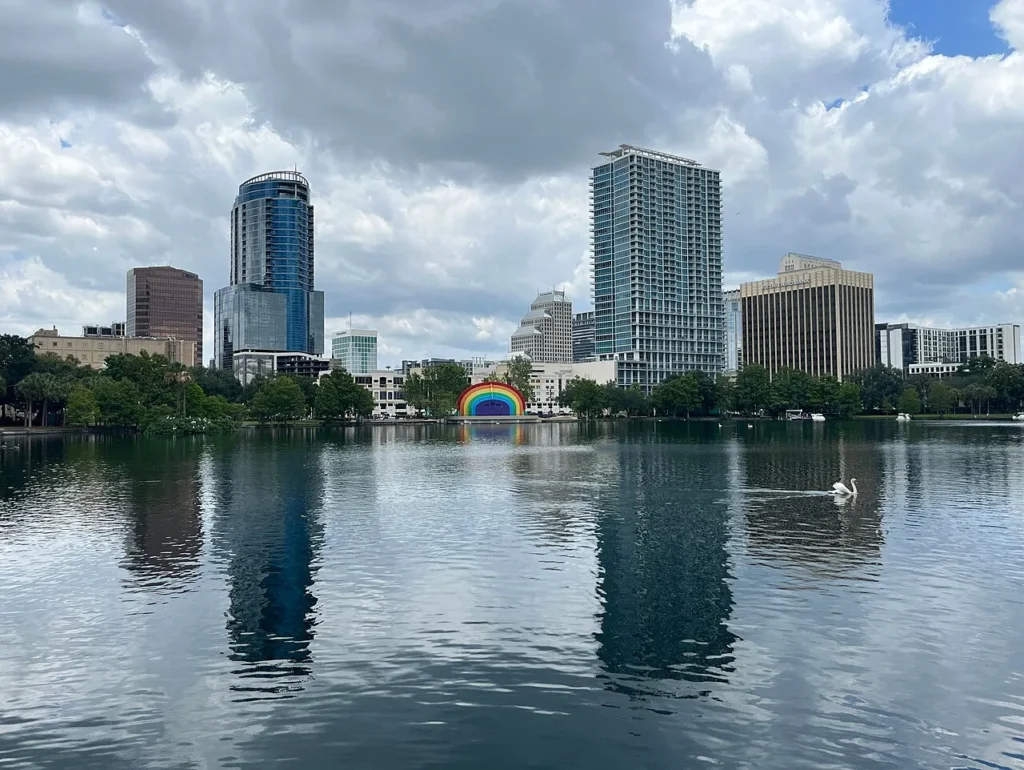
This page is the hub for our monthly Orlando guides. The climate figures come from NOAA’s National Centers for Environmental Information, the National Weather Service (NWS) office in Melbourne and the National Hurricane Center (NHC), checked in October 2026.
Quick answer: Orlando’s most comfortable months are November through April, with average highs from the low 70s to the low 80s and rain on only 6 or 7 days a month. May is hot and mostly dry, the wet season usually starts in late May, and June through September bring highs near 90°F, 14 to 17 rainy days a month and frequent lightning. Hurricane season runs June 1 to November 30 and peaks around September 10. Choose a heated pool for December to February and indoor space plus a free-cancellation rate for June to mid-October. For winter 2026–27, the NWS Melbourne outlook favors wetter, stormier weather than usual.
Check Orlando hotel prices for your dates
On this page
Orlando weather by month: the NOAA numbers
Climate normals are 30-year averages: they show what a month usually looks like, not what a given day will do. The table uses NOAA’s 1991–2020 monthly normals for Orlando International Airport (station USW00012815); rain days are days with at least 0.01 inch.
| Month | Avg high | Avg low | Rain | Rain days |
|---|---|---|---|---|
| January | 71.8°F | 49.5°F | 2.48 in | 7.0 |
| February | 74.9°F | 52.4°F | 2.04 in | 6.4 |
| March | 78.9°F | 55.8°F | 3.03 in | 6.8 |
| April | 83.6°F | 60.7°F | 2.58 in | 6.3 |
| May | 88.4°F | 66.3°F | 4.02 in | 8.4 |
| June | 90.8°F | 71.6°F | 8.05 in | 16.2 |
| July | 92.0°F | 73.2°F | 7.46 in | 17.1 |
| August | 91.6°F | 73.7°F | 7.69 in | 17.2 |
| September | 89.6°F | 72.4°F | 6.37 in | 14.2 |
| October | 84.7°F | 66.2°F | 3.46 in | 8.4 |
| November | 78.3°F | 58.2°F | 1.79 in | 6.0 |
| December | 73.8°F | 52.9°F | 2.48 in | 7.1 |
The averages hide three things. Heat: the airport averages about 110 days a year at 90°F or hotter, nearly all from May to September, including about 25 in July. Cold snaps: January averages 16 nights at 50°F or colder and nearly 5 at 40°F or colder, and a freeze happens about 1.6 nights a year, mostly in December and January. Normal snowfall is zero. Rain: June to August average 23.2 inches between them, out of 51.45 inches a year, while December to February get 7 inches.
What drives crowds and what to pack, month by month
NOAA doesn’t measure crowds, so this table pairs each month with the holidays and events that fill Orlando hotels. Dates are the next occurrence of each: 2026 for November and December, 2027 for the other months. Our guide to the best time to visit Orlando weighs these against school breaks in more detail.
| Month | What drives demand | What to pack |
|---|---|---|
| January | Marathon Weekend Jan 6–10; MLK Day Jan 18 | Layers and a jacket for nights |
| February | Universal Mardi Gras from Feb 6; Presidents’ Day Feb 15; Princess Half Feb 25–Mar 1 | Layers; swim in heated pools |
| March | Spring-break weeks; Flower & Garden from Mar 10; Easter Mar 28 | Sunscreen, light evening layer |
| April | Easter week; last spring-break weeks | Sunscreen and a hat |
| May | Memorial Day May 31; wet season from about May 27 | Sun protection; poncho late in month |
| June | Summer break; Juneteenth observed Jun 18 | Poncho, quick-dry clothes, water bottle |
| July | Independence Day observed Jul 5; peak lightning | The same, plus an indoor midday plan |
| August | Halloween Horror Nights from late August (Aug 28 in 2026) | Poncho, sunscreen, spare shirts |
| September | Labor Day Sep 6; hurricane peak Sep 10 | Poncho; refundable bookings |
| October | Halloween events; Columbus Day Oct 11; dry season from about Oct 15 | Light layers by late month |
| November | Veterans Day Nov 11; Thanksgiving Nov 26; holiday season from mid-month | Layers for cool nights |
| December | Christmas to New Year; EPCOT Festival of the Holidays | Jacket for nights |
Winter in Orlando (December to February): dry, mild, cool nights
Winter is the coolest and driest stretch. Average highs run from 71.8°F in January to 74.9°F in February, lows from 49.5°F to 52.9°F, and rain totals 2 to 2.5 inches a month on 6 or 7 days. The US Naval Observatory puts sunset at 5:40 p.m. in Orlando on January 1. The NWS gives November 5 as the median date of Orlando’s first temperature below 50°F. Pack a jacket for mornings and evenings, not a winter coat.
This winter may not be typical. NWS Melbourne’s 2026–2027 dry season outlook, issued September 30, 2026, says a very strong El Niño raises the odds of wetter-than-normal conditions across central Florida from November to April, with more storminess and a higher potential for severe weather, including strong tornadoes. Temperatures lean toward near normal. Pack rain gear and keep weather alerts on your phone.
What it means for your hotel: swimming is still possible, but only in heated water, and getting out at a 50°F dusk is chilly even then. Hotels that publish a pool temperature beat hotels that just say “heated”; we list them in our guide to Orlando hotels with heated pools, and Orlando hotels with indoor pools remove the question entirely.
Hilton Orlando Buena Vista Palace: heated pools by Disney Springs


The Hilton Orlando Buena Vista Palace states its pool temperature outright: its FAQ says the pools are heated to between 82 and 85 degrees and open 7 a.m. to 11 p.m. daily. Disney Springs is a 5-to-7-minute walk, an hourly shuttle serves all four Disney parks (reservations required both ways), and the hotel offers Disney’s 30-minute Early Theme Park Entry. At the time of writing, the resort charge was $41 plus tax per night, including float lagoon access, with self-parking at $38 and valet at $48 plus tax. Our Hilton Orlando Buena Vista Palace review has the room details.
See prices and availability at Hilton Orlando Buena Vista Palace
Spring in Orlando (March to May): warm days, last dry weeks
Spring warms fast. The average high climbs from 78.9°F in March to 83.6°F in April and 88.4°F in May. March and April stay dry (3.03 and 2.58 inches on 6 to 7 days), and 90°F days go from rare in March (0.8 on average) to occasional in April (3.6) and routine in May (13.6). The NWS gives May 27 as the median start of Orlando’s wet season.

EPCOT’s Flower & Garden Festival is scheduled for March 10 to May 31, 2027, and Easter falls on March 28. Island H2O Water Park in Kissimmee calls itself a seasonal park operating from March to October; its 2026 season runs to October 31, so check its calendar for 2027 opening dates. Our spring break in Orlando guide covers the 2027 crowds.
What it means for your hotel: by April, pool heating stops mattering, and a resort with its own slides and lazy river saves you a water-park ticket on warm days.
The Grove Resort & Water Park Orlando: pools kept at 83°F
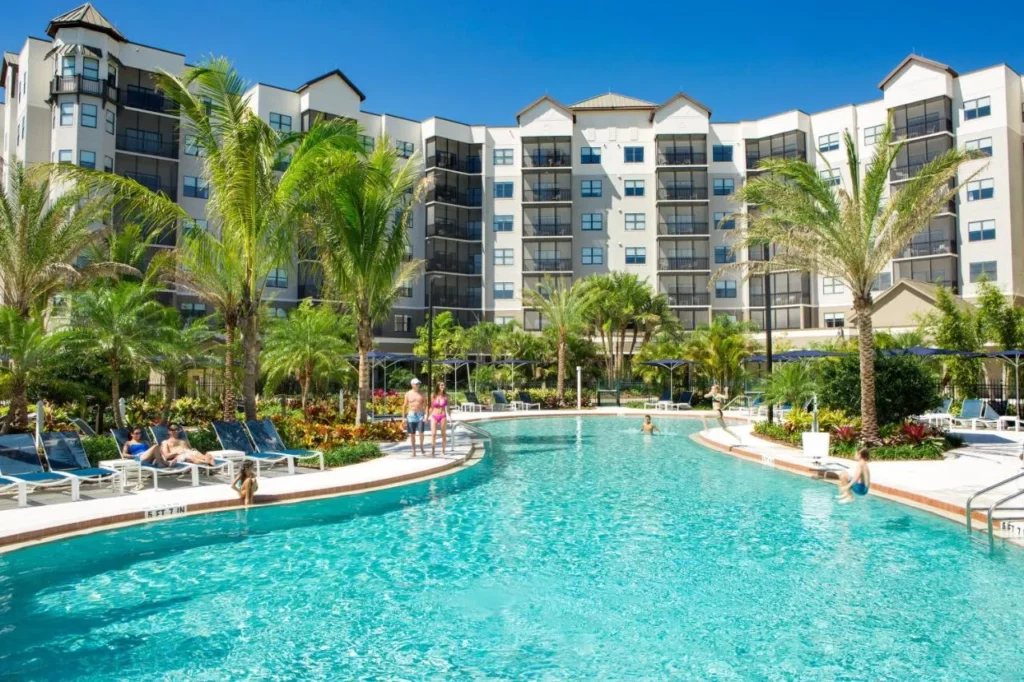

The Grove’s FAQ says its Springs Pools and the zero-entry pool at Surfari Water Park are kept at 83 degrees year-round. Surfari, with slides, a FlowRider and a lazy river, opens 10 a.m. to 5 p.m. Sunday to Friday and to 7 p.m. on Saturday, weather permitting. The family suites have full kitchens and washer-dryers. The resort fee, $49 plus tax per night at the time of writing, covers Surfari and daily shuttles to Walt Disney World, Universal and SeaWorld (reserve up to 48 hours ahead and at least 2 hours before departure); parking is $35 plus tax a night. The resort says it is six miles from the Disney parks; on public roads it’s about 7.5 miles to Animal Kingdom’s parking entrance. See our Grove Resort Orlando review.
Check your dates for The Grove Resort & Water Park Orlando on Booking.com
Summer in Orlando (June to September): heat, humidity, daily storms
Average highs are 90.8°F in June, 92.0°F in July, 91.6°F in August and 89.6°F in September, and lows stay in the low 70s. Rain jumps to between 6.37 and 8.05 inches a month, falling on 14 to 17 days.

The storms follow a rhythm. NWS Melbourne explains that the Gulf and Atlantic sea breezes collide over the peninsula each day, and the collision “often produces widespread storms with frequent lightning and heavy rainfall.” The NWS calls the corridor from Tampa Bay to Titusville, with Orlando in the middle, “Lightning Alley”: it gets the most lightning in the US, and more than 90 percent of it strikes from May through October, between noon and midnight. July is Florida’s peak month for lightning, and NWS records since 1959 show Florida with the most lightning casualties of any state.
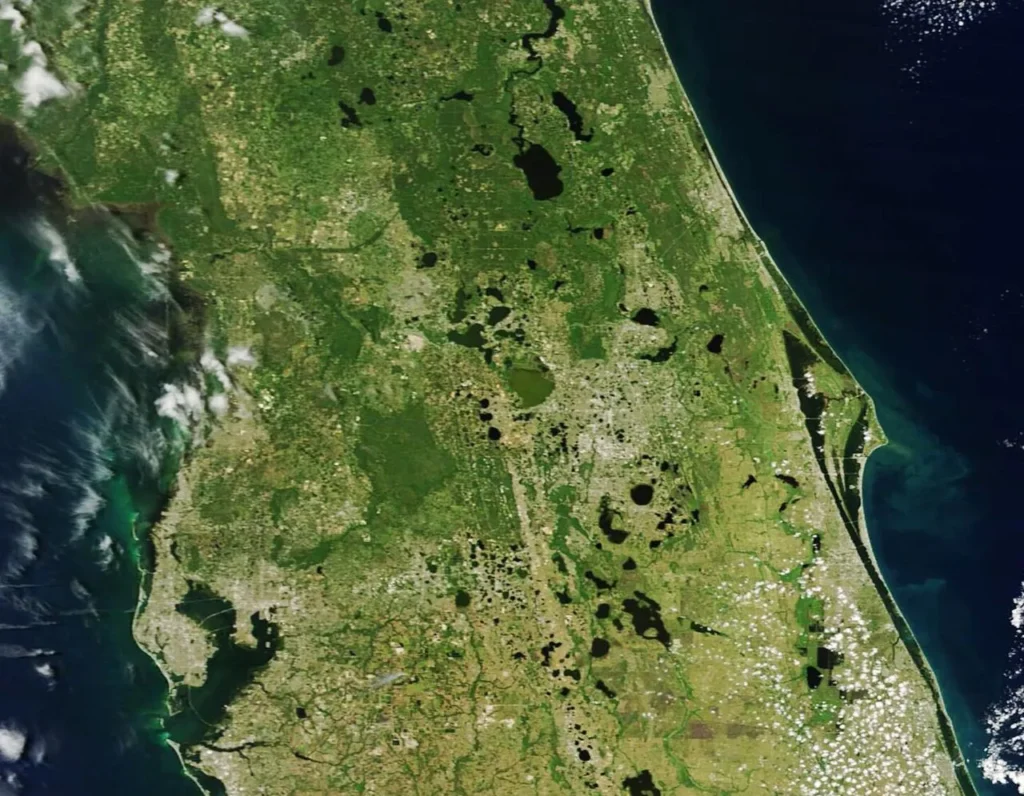
Heat is the other factor. On the NWS heat index chart, for example, 92°F (July’s average high) at 55 percent relative humidity feels like 101°F, in the “extreme caution” band, and full sunshine can add up to 15°F. SeaWorld and Aquatica even list a heat index of 110°F as a trigger for their weather guarantee.
What it means for your hotel: plan park mornings and pool or indoor afternoons. Pools and water parks typically clear the water when lightning is near, and the NWS rule is “When thunder roars, go indoors,” then wait 30 minutes after the last thunder. A short drive back for a midday break, or a resort with real indoor space, earns its keep in July.
Gaylord Palms Resort: 4.5 acres under glass


Gaylord Palms Resort & Convention Center in Kissimmee is built around 4.5 acres of glass-roofed garden atriums, with restaurants and walkways inside, which Marriott says are kept at 72 degrees. Outside, the three-acre Cypress Springs Water Park has seven waterslides, a rapid river and a zero-entry pool, and the resort lists two heated pools. The resort fee, $45 plus tax per day at the time of writing, covers four water-park wristbands per room and the daily shuttle to the Disney parks and Disney Springs. Marriott’s July 2026 page listed parking at $40 self and $55 valet, but the resort’s Christmas FAQ says $38 self-parking, so confirm. Check-in requires guests 18 or older. Animal Kingdom’s parking entrance is about 4 miles away by road. Read our Gaylord Palms Resort Orlando review.
See available rooms at Gaylord Palms Resort & Convention Center
Rain and the theme parks

Rain rarely closes a theme park, but lightning pauses outdoor rides, pools and water parks until it passes. Disney says at least one of its water parks is open each day except on days with inclement weather. SeaWorld’s and Aquatica’s Weather-or-Not Assurance offers a return visit if weather closes the park early or rides close for over 60 minutes because of lightning, strong winds, heat, rain or snow; requests must be made within a week. Pack a poncho and see our guide to things to do in Orlando when it rains.
Hurricane season (June 1 to November 30) and your booking

The NHC puts the peak of the Atlantic season on September 10, with most activity between mid-August and mid-October, and says an average season (1991–2020) has 14 named storms, 7 hurricanes and 3 major hurricanes across the basin. Most never reach Orlando, which is inland and spared storm surge, but the risk is real. According to the NHC’s report, Hurricane Ian (2022) brought 10 to 20 inches of rain to central and eastern Florida, with major floods affecting Orange, Osceola, Seminole and Lake counties. Hurricane Milton (2024) put Orange County under a hurricane warning, closed Walt Disney World for a day and halted commercial flights at Orlando International Airport.
What it means for your hotel: book free-cancellation rates for late August to mid-October and buy any travel insurance before a storm is named. Disney’s hurricane policy (in the latest full copy we could read, from 2022) and Universal’s severe weather policy (June 2026 copy) let you reschedule or cancel direct bookings without their fees if a hurricane warning is issued for Orlando or your home area within seven days of arrival; Universal also counts tropical storm warnings and states of emergency. Confirm the current terms before you book. A Booking.com stay follows the hotel’s own terms. Our Orlando hurricane season guide covers the details.
Fall in Orlando (October and November): the dry season returns
October is the hinge month. Highs fall from 84.7°F to 78.3°F in November, lows from 66.2°F to 58.2°F, and rain drops from 3.46 to 1.79 inches, making November the driest month. The NWS gives median dates of October 15 for the start of the dry season and October 19 for the first temperature below 60°F, and says lightning drops dramatically in November as high pressure brings dry air.
The calendar stays busy: Halloween Horror Nights runs on select nights through November 1, 2026, the EPCOT Food & Wine Festival to November 21, and the holiday seasons start November 13 at Disney (ticketed holiday parties from November 7) and November 14 at Universal. Volcano Bay closes for maintenance from October 26. Early October is still peak hurricane season, so keep refundable rates until mid-month.
Pools and water parks by season
Disney, Universal and Aquatica all say their water parks are heated, which is why some stay open in winter. Here is each park’s status on the official pages in mid-October 2026.
| Water park | Heated (official) | Status at the time of writing |
|---|---|---|
| Disney’s Typhoon Lagoon | About 81°F | Closed for refurbishment; no reopening date posted |
| Disney’s Blizzard Beach | About 81°F | Open; at least one Disney water park opens daily, weather permitting |
| Universal Volcano Bay | Over 80°F (2018 Universal blog) | Open to Oct 25; closed Oct 26, 2026, reopening planned by Apr 1, 2027 |
| Aquatica Orlando | 82°F all year (2022 Aquatica blog) | Open; hours vary, check the calendar |
| Island H2O Water Park | Not stated | Seasonal, March to October; 2026 season ends Oct 31 |

Many hotel pages say “heated” without a number; the two above publish one (82 to 85°F at the Buena Vista Palace, 83°F at The Grove), so ask before a winter stay. Our Orlando water parks guide covers tickets and parking.
Month-by-month Orlando guides
- Orlando in January: Marathon Weekend and the coolest nights.
- Orlando in February: Presidents’ Day and Mardi Gras.
- Orlando in March: spring break and Easter 2027.
- Orlando in April: the warm end of the dry season.
- Halloween in Orlando: Horror Nights and where to stay.
- Christmas in Orlando: holiday events and hotels.
Month-by-month guides: Orlando in May, Orlando in June, Orlando in July, Orlando in August, Orlando in September, Orlando in October, Orlando in November, Orlando in December, with events, school breaks and crowd weeks.
Frequently asked questions
What is the hottest month in Orlando?
July, by a small margin. NOAA’s 1991–2020 normals for Orlando International Airport give July an average high of 92.0°F and low of 73.2°F, with about 25 days at 90°F or hotter. August is almost identical at 91.6°F. Humidity pushes the heat index well above the air temperature, so plan park time for mornings and evenings.
What is the coldest month in Orlando?
January, with an average high of 71.8°F and low of 49.5°F. The airport averages 16 January nights at 50°F or colder and nearly 5 at 40°F or colder. A freeze happens about 1.6 nights a year, almost always between December and February, and normal snowfall is zero, so pack layers and a jacket rather than winter gear.
What is the rainiest month in Orlando?
June, with a normal of 8.05 inches on about 16 days, followed by August (7.69 inches) and July (7.46 inches). The NWS gives median dates of May 27 for the start of the wet season and October 15 for the dry season. Summer rain mostly comes as afternoon thunderstorms. November is the driest month, with 1.79 inches on 6 days.
When is hurricane season in Orlando?
June 1 to November 30, the Atlantic hurricane season as defined by the National Hurricane Center, with a peak on September 10 and most activity from mid-August to mid-October. Orlando is inland and avoids storm surge, but Ian brought major flooding to the area in 2022, and Milton closed Walt Disney World for a day and halted flights at Orlando International in 2024. Book refundable rates for late-summer and early-fall trips.
Can you swim in Orlando in winter?
Yes, in heated water. Disney says Blizzard Beach is heated to about 81°F, Aquatica’s blog says 82°F all year, and the Hilton Orlando Buena Vista Palace (82 to 85°F) and The Grove Resort (83°F) publish their pool temperatures. An unheated pool is cold when the afternoon high is 72°F, so check before you book a December-to-February stay.
Which months have the best weather in Orlando?
For comfortable park days, mid-October through April: average highs from the low 70s to the low 80s, about 6 to 8 rainy days a month and little lightning. November is the driest month, and April adds warm pool weather before the summer storms. The trade-off is demand around Thanksgiving, Christmas, Presidents’ Day, spring break and Easter, so compare date-based ticket prices.
Bottom line
Orlando’s weather is predictable by month even when it isn’t by day: dry and mild from mid-October to April, hot with daily storms from June to September, and hurricane season over the second half of the year. Match the hotel to the season, with a published pool temperature in winter, indoor space in summer and a free-cancellation rate from late August to mid-October, then open the monthly guide for your dates.
Sources checked in October 2026: NOAA NCEI 1991–2020 monthly normals, Orlando International Airport, NWS Melbourne wet and dry season onset, NWS Melbourne 2026–2027 dry season outlook, National Hurricane Center tropical cyclone climatology, Disney’s Blizzard Beach water park